


Executive Summary
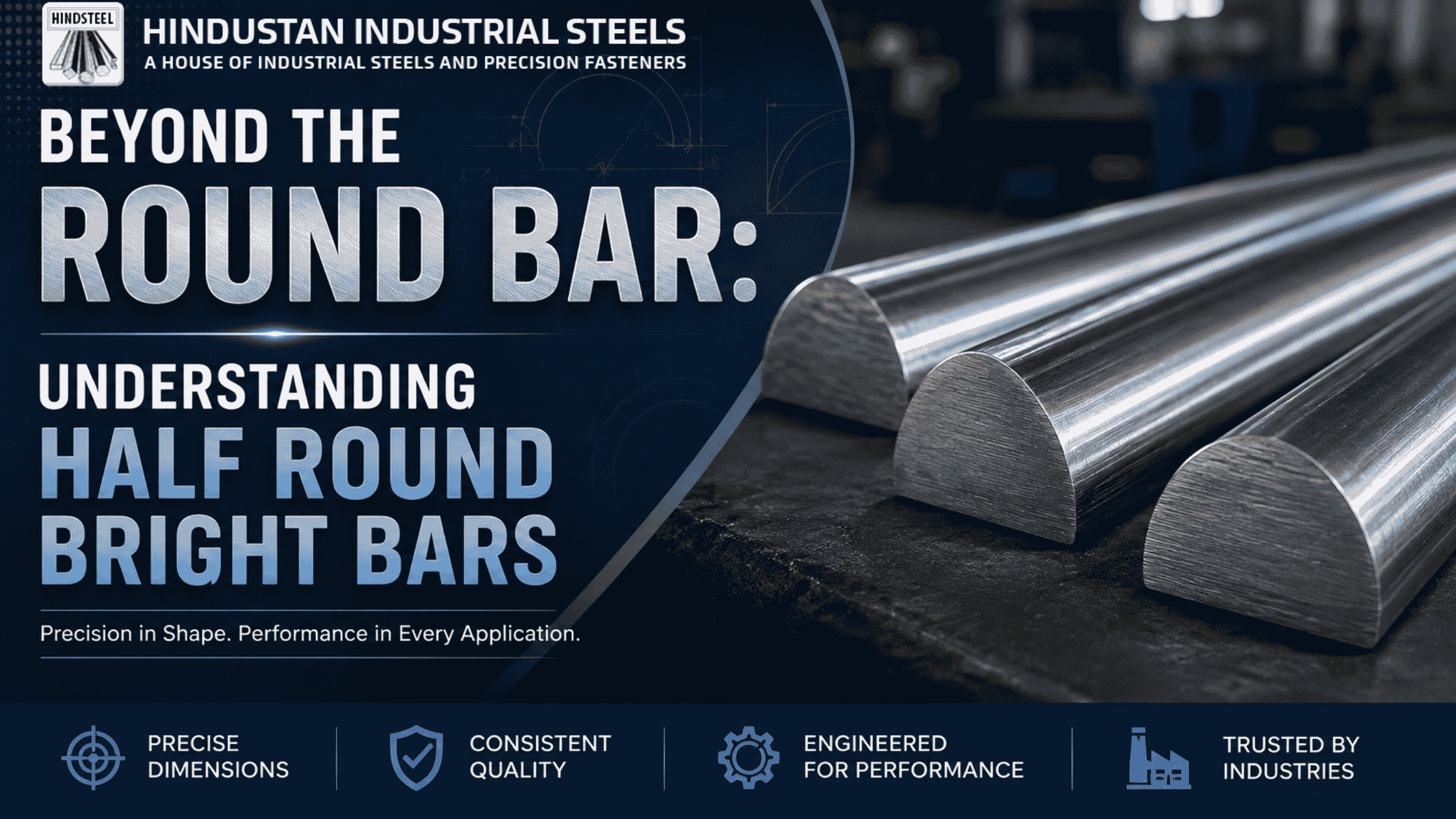
Half round bright bars are steel rods shaped like a half-circle. They have one side and one curved side. Companies make these bars by pulling them through dies or rolling them with care to make sure they are the exact right size and have a shiny finish. You can find them in types of steel like mild carbon steel (for example SAE 1010/1018 or EN8/EN8D) and stainless steel (304/316). Some people also use alloy or bearing steels for heavy jobs. Usually the size accuracy follows ISO class h10–h11 and the bars stay quite straight within about 1.5 mm for every meter. People use Half round bright bars for many things like building railings making car parts working on boats or food machines making furniture and building precise machines. When you pick a bar you need to match the material the shape and the finish to what you're building. You also need to give the size and how much error is allowed. To make sure the quality is good workers check the size, the surface and how straight the bar is. They also do strength tests and other checks to make sure the metal is perfect.
What Is a Half Round Bright Bar?
A Half round bright bar is a piece of steel that has been finished while cold and it looks like a half-circle. It has one face and one curved face. This shape is great because it acts like a bar for strength but also has a nice smooth edge. When we call a bar "bright " it means the surface is smooth and shiny because it was polished or pulled through a die, not rough like hot-rolled steel. Half Round bright bars are much more accurate in size and look much better than hot-rolled metal. This makes half round bright bars perfect for jobs where everything needs to fit just right and look good.
Figure: Common shaped steel bar profiles (diagram). The half round bright bar has one flat side and one rounded side, which needs careful cold-forming to get that smooth bright finish.
Manufacturing Methods
Half-round bright bars are made by cold drawing or precision rolling from hot-rolled steel. Here is how the process usually works:
Picking the material: First workers choose high-quality steel billets. They might pick steel, medium-carbon steel like EN8/EN9 or stainless steel depending on how strong or rust-proof the bar needs to be. These billets come with papers called Mill Test Certificates to prove what is in the metal.
- Cleaning the surface (Pickling): Hot-rolled bars have a layer on them. Workers use an acid bath to clean this off and then wash the bars with water.
- Cold drawing (Making the shape): The cleaned bar is pulled through a tool called a die that is shaped like a half-circle. This process makes the bar longer and stronger while giving it a smooth surface. The die is made carefully so the width, thickness and curve are all correct. This also makes the metal harder.
- Annealing (Softening): After drawing the bar can be a bit too hard and brittle. Annealing is a process where the bar is heated up and cooled down slowly. This makes the metal easier to work with and less stressed.
- Straightening and finishing: After annealing the bars are straightened out. They might get a polish to make the bright surface look even better. Sometimes they are ground down more if someone needs extreme precision.
- Cutting to length: Finally the bars are cut to the length the customer wants. They are packed carefully with oil to stop rust so they stay shiny during shipping.
Throughout the process workers watch everything closely to make sure the size and finish are right. For half round bright bars it is very important to get the curve and the width just right and to avoid any marks on the surface. Good makers follow rules like IS 9550 or ASTM to keep things consistent.
Materials and Grades
You can make half round bright bars out of almost any kind of steel. Here are the common ones:
- Mild/Low-Carbon Steel (like SAE 1010/1018): These are cheap and easy to cut and shape. They are good for jobs where you do not need massive strength.
- Medium-Carbon Steel (like EN8, EN8D or C45): These are stronger and harder than steel. EN8D is a common choice in India for precision bars because it is tough but still easy to work with.
- Free-Cutting Steel (like 12L14): This steel has extra bits like sulfur in it to make it very easy to machine.
- Alloy Steel: Grades like 4140, EN24 or Boron steel are much stronger. Can handle more wear. These are used for heavy-duty parts like bolts or shafts. Often need heat treatment later.
- Stainless Steel (304/316): These are used when you need to stop rust or want a look. Stainless half round bright bars are used a lot in boat parts, food machines and pretty railings.
- Special Steels: You can also get bearing steel or spring steel in a half-round shape if a customer asks for it.
Makers usually keep grades in stock but can also make custom alloys. You should always pick a grade that fits your job like using C45 for parts or 316L for things used near the ocean.
Dimensions and Tolerances
Half round bright bars are measured by how wide they are, how thick they are and how big the curve is. They come in sizes from very tiny ones (like 3mm×1.5mm) to very large ones (over 100mm wide). For example one supplier sells sizes from 6mm×3mm up to 30mm×15mm. They can make larger ones too.
The allowed error or tolerance depends on how the bar's finished. Cold-drawn bright bars usually follow ISO rules like h10 or h11. For example Hindsteel says their half round bright bars are made to h10/h11 accuracy. According to the standard IS 9550 a 10–18mm half round bar has a very small allowed error. For shapes that're not round the rules say the shape should not be too far off from the standard. Here are some common examples:
- Width (the side): For a width of 6–18mm an h11 tolerance might allow a difference of –0.11mm.
- Thickness (the part): For 6–10mm thickness the error might be –0.09mm and for 10–18mm it might be –0.11mm.
- Radius (half the curve): This is kept to the standard. If the width is 20mm the radius is 10mm. The error might be around –0.08mm.
- Straightness: Usually a bright bar should not bend more than about 1.5 mm for every meter of length.
If you need things to be more exact you can ask for ISO h9 or a ground finish. It is very important to tell your supplier what width, thickness and radius you need so there are no mistakes.
Applications of Half Round Bright Bars
Half round bright bars are used whenever a half-circle shape is needed for looks or for a job. Common uses include:
- Architecture & Interior Design: They are used for handrails, decorative edges and trim for stairs. The smooth shiny shape feels good to hold.
- Furniture & Fixtures: People use half round bright bars to make frames for tables, chairs or railings because they look nice and are strong.
- Automotive & Machinery: Some custom parts like machine guides or covers use these bars so that workers do not have to cut the curve themselves. This saves time.
- Marine & Food Equipment: half-round bright bars are used for kitchen trim and boat parts because they do not rust and are easy to keep clean.
- Manufacturing Fixtures: These bars can be used as edges on tools and jigs to help guide parts during work.
- Reinforcement & Guarding: Sometimes a half round bar is used as a bumper or a support in building projects.
- Custom Parts: Any part that needs a half-circle shape—like machine links or even things you buy in stores—can start as a half-round bright bar to save work.
Using this shape usually means you do not have to cut away much metal as you would with a square bar and the shiny finish means you do not have to polish it as much later.
Choosing the Right Half Round Bright Bar
When you are picking a half round bright bar for your project here is what you should do:
- Pick the material: Choose a grade based on strength and rust needs. Use steel for simple things EN8 for strength or 316 stainless for the ocean.
- Give sizes and tolerances: Tell the maker exactly how wide, thick and curved the bar should be. Tell them how much error is okay (like h10 or h11) and how long you need them to be.
- Decide on the finish: If you need it to be super smooth ask for a " drawn and ground" finish. Decide if you want the bar to be soft (annealed) or hard (as-drawn).
- Follow the rules: Check standards, like IS 9550 or ASTM to make sure you are getting the quality.
Check for quality: For parts ask for a Mill Test Certificate. This proves the metal is what the seller says it is. You can also ask for tests that check how hard or strong the metal is.
Work with a Good Supplier: You should pick manufacturers or distributors that are known for making quality bright bar production. You must check if they have the skills if they can make custom shapes and if they have good quality systems. A reliable supplier will help you understand the specs and make sure the final product matches your design.
If you clearly state what you need—like the use, the material, the size, the finish and the quality checks—you can avoid mistakes. Mistakes like picking the grade getting the wrong size or having a bad finish are easy to avoid if you are careful. For example Saky Steel tells buyers to "define tolerance thickness tolerance, straightness, length tolerance, edge shape and permissible defects" when they place an order.
Quality and Inspection Practices
Making sure your half round bright bars are high quality is very important for precision work. Here are the main things to check:
- Dimensional Inspection: Use tools like calipers or micrometers to check the width, thickness and radius. Every bar needs to match the drawing within the ISO tolerance (like h10/h11). You can also use profile gauges to make sure the semi-circular shape stays the same all the way down the bar.
- Surface Finish: The bright bar should feel smooth and look polished. Look closely for any scratches, pits, seams or rust. Any marks on the side or the curved side must be within what you agreed upon. Often good quality bars have a mirror- finish because of how they are made.
- Straightness: Use a straightedge or a laser to see if the bar is bent. According to IS 9550 the straightness error is usually limited to about 1.5 mm per meter. If the bar is not straight it will cause problems when you try to build or machine it.
- Mechanical Testing: Sometimes people test samples of the bars for things like tensile strength, yield strength, elongation and hardness. This proves the material is actually what it says it is. This is very important for alloy grades or parts that're critical to safety. Manufacturers always keep records of these tests.
- Non-Destructive Testing: For parts that're very important for safety like pressure vessels you can use methods like magnetic particle inspection (MPI) or ultrasonic testing to find hidden flaws inside the metal. Many bright-bar suppliers offer MPI/UT along with their mill certifications.
- Mill Test Certificate (MTC): You should always ask for an MTC or a heat certificate. This paper proves the chemical makeup and the strength of the metal. This paperwork ensures the steel grade is right and that the steel was heated and treated the way.
- Documentation: Good suppliers write down all these checks. They usually give you a test certificate. Might put batch marks on the bars so you know where they came from.
To put it simply a good quality control process uses the tools and tests. As one industry source says, bright bars should "undergo MPI, ultrasonic testing, dimensional checks, mechanical testing and material analysis". Keep all the results in writing. Good quality control stops surprises later on.
Frequently Asked Questions
Q: What is a half round shape bright bar?
A half round bright bar is a steel bar that has been cold-drawn into a semi-circle shape. It has one side and one curved side. It has a polished surface, which is why it is called a "bright" finish and it has very exact sizes.
Q: How does a round bar differ from a half round bar?
A round bar is a circle. A half-round bar has one side that's flat. People choose a half-round bar when they need a surface to mount something or if they want it to look nice. It also means you do not have to do much machining on one side.
Q: What materials can half round bright bars be made from?
They can be made from types of steel. This includes steel (like SAE 1010/1018) medium-carbon steel (like EN8/EN8D) free-cutting alloys (like 12L14) stainless steel (like 304/316) and other special alloys or bearing steels. The material you pick depends on how strong you need it to be and if it needs to resist rust.
Q: What industries or applications use half round bright bars?
You can find them in things like handrails, furniture and trim for buildings. They are also used in car parts, machine parts, marine equipment and food-service tools. They are used anywhere a semi-circle shape is needed for how it works or how it looks.
Q: How do I specify the half-round bar?
First think about what the bar will do and where it will be used. Then pick the steel grade. Tell the supplier the width thickness, radius, length and tolerances you need (like h10/h11). You should also say what kind of surface finish you want. If you need any special tests or certificates.
Q: Can these bars be made to custom dimensions?
Yes they can. Most manufacturers keep sizes in stock but they can make custom half-round bright bars if you ask. For example Hindsteel makes custom parts based on drawings from their clients including widths and radii.
Q: What quality checks are important for half-round bars?
Checking the size (width, thickness radius) and making sure the bar is straight are the important things. The surface should be bright. Have no flaws. For important parts you should also ask for mechanical tests and NDT (like MPI/UT). Always ask for a Mill Test Certificate to prove the metal is correct.
Conclusion
Half round shape bright bars offer a special shape with the precision of cold-drawn steel. By picking the steel grade, size and finish engineers can get many benefits like spending less time machining and making things look better. The best way to get a shape is to be very clear, about the flat width, the curved radius and the tolerances. You should work with Half round shape bright bar manufacturers who know how to handle custom shapes and strict quality rules. If you specify everything clearly and check the quality your bars will fit perfectly into your projects. Make your designs more reliable.