


Small changes in the shape of raw materials have an impact on the time taken to manufacture and amount of material consumed in the process in the industrial environment. The steel bars come in various forms; however, the hexagonal steel bars become extremely important in situations where a part requires flat faces to be machined or tightened.
Nuts and bolts, hydraulic fittings, and machine parts are examples of some of the many manufacturing processes that involve the use of hexagonal steel bars. The hexagonal shape of the steel bars allows manufacturers to manufacture certain components without having to machine the flat faces out of round steel bars.
What Are Hexagonal Steel Bars?
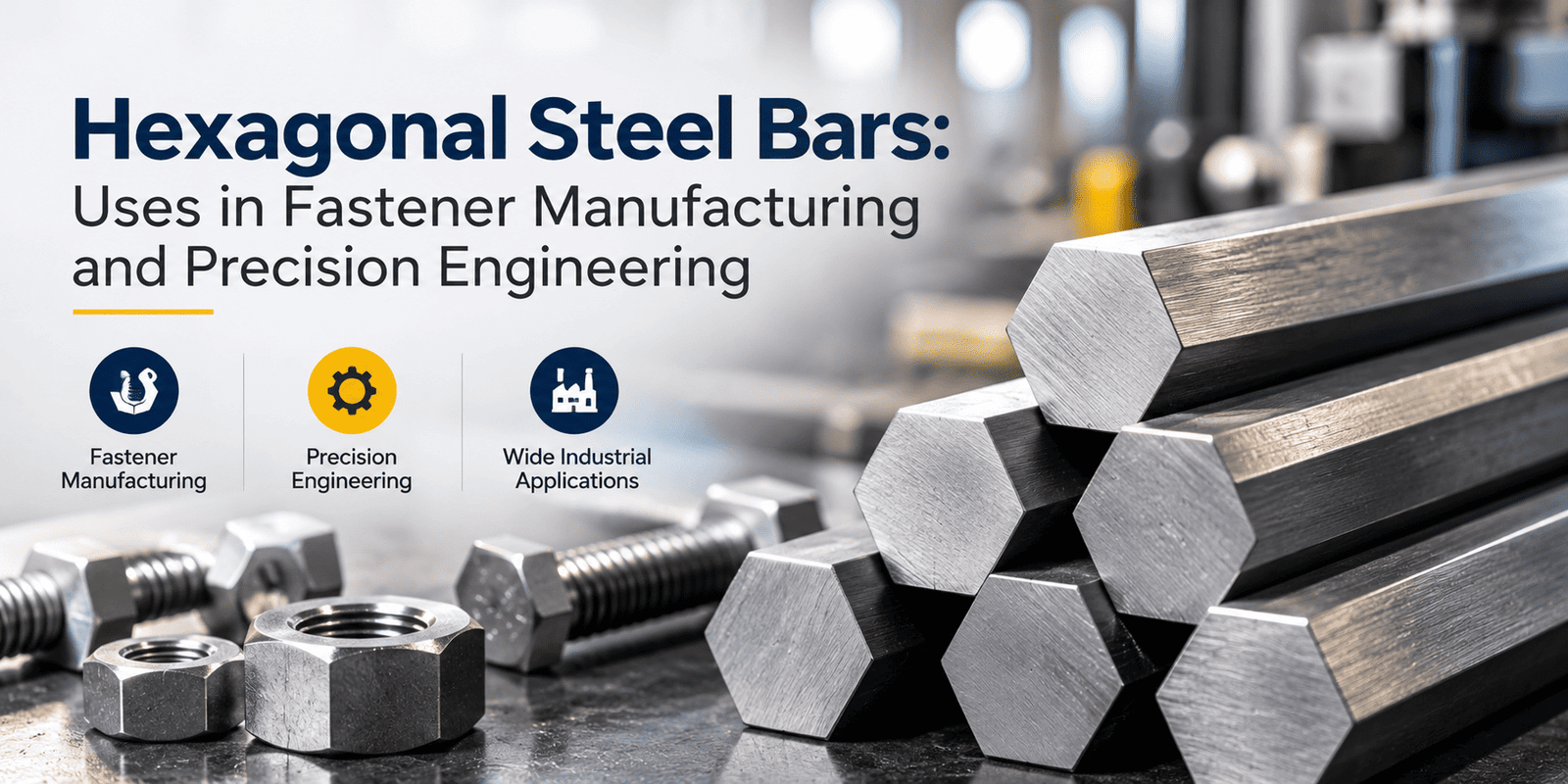
Hexagonal Steel Bars are made out of solid steel which has six sides and six edges. In contrast to round bars, which have a circular section, hexagonal bars feature pre-made flat faces that can be held by certain tools or built-in as part of the final product.
The bars can be supplied in various grades of steel and finishes, depending on the purpose of use. They can come as hot-rolled bars and as cold-drawn bars called bright bars.
A bright hexagon bar is created as a result of cold-finishing process that can result in better surface finishing and more precise dimensioning.
To understand how different steel bar shapes are manufactured, you can also read our guide on understanding bright bars, their manufacturing process, types, and industrial impact.
Why Are Hexagonal Steel Bars Used in Fastener Manufacturing?
While fasteners seem to be a fairly uncomplicated part, their production calls for great care concerning dimensions, materials used, and accuracy of the threads.
Hexagonal steel bars are good in the sense that the form is similar to the form of many fasteners. It is not necessary to start with a round bar and machine six faces.
Here are some common applications.
1. Manufacturing Hexagonal Nuts
Hexagonal nuts are some of the most common uses of hexagonal steel bars.
In the case of machining process for nut manufacturing, the manufacturer can cut the hexagonal steel into appropriate lengths, drill the hole in the center, and make the thread inside. Further processing like chamfering and finishing might be needed based on the nut type.
The use of hexagonal shape will minimize the need for outside milling since there are already six flats.
But it should also be noted that large quantities of standardized nuts can also be made through cold forming and hot forging processes.
2. Producing Bolts and Special Fasteners
Some types of bolts and screws can be machined out of hexagonal steel bar stock.
Because of its six faces, hex bar stock lends itself well to being tightened or loosened via a wrench or socket of the correct size. In some industrial applications, hex bar stock could make a good starting material if fastener sizes aren’t appropriate.
3. Manufacturing Threaded Fittings
Most industrial fittings call for both thread and flat surfaces.
Steel bars having hexagonal shape make it possible to manufacture a fitting with an integral grip. This is especially applicable in some hydraulic fittings, adaptors, couplings, and machine tools fittings.
The finished product may be grasped by a wrench without the need for an additional gripping element.
Applications of Hexagonal Steel Bars in Precision Engineering
Hexagonal steel bars are not only useful in making nuts and bolts. Due to their shape, they can be used in other parts that require flat surfaces and proper machining.
Automotive Components
Steel elements are widely used in automotive manufacturing and include fasteners, adapters, threaded connections, and connectors.
The hexagonal form of steel rods is used for cases where wrench flats or a six-sided outer surface of the element is required.
The selection of steel grade should be done based on the mechanical properties of the elements.
Hydraulic and Pneumatic Equipment
The use of threaded connections is common in hydraulic and pneumatic systems, which need to be installed properly.
Hexagonal steel bars are effective in making components that require an external surface for gripping.
In such cases, precision in measurements becomes very crucial since the final product needs to fit with particular threads and seals.
Industrial Machinery
Industrial machines have many smaller components which play important roles in assembling, setting up, or maintenance.
These hexagonal bars made of steel are useful to produce certain type of nuts, screws, adjusting elements, among others.
Their plain surface allows them to be suitable in places where a component should be adjusted by means of a tool.
Precision-Machined Components
The material of choice for machining plays a major role in how much machining is necessary in the process of forming the desired shape in Precision Engineering.
Where there is a part that needs to have a hexagonal shape on the outside, having a hexagonal starting material would help decrease the number of machining processes.
This is especially useful where there are many identical parts being made, as it helps save a small amount of machining time in each part.
How Hexagonal Bright Bars Are Manufactured
Bright hexagonals are usually produced by cold drawing, but this is dependent on the quality level, dimensions, and finishing of the material to be produced.
These stages include the following.
Selection of Raw Material: Steel is chosen based on the chemical composition and mechanical properties needed for the desired application.
Surface Treatment: The raw material is cleaned and treated to make it more capable of going through the drawing process.
Cold Drawing: The metal is drawn through a specially designed die to get the desired hexagonal shape and dimensions.
Straightening and Cutting: The drawn rods are straightened and cut to the desired dimensions.
Inspection: The final product is inspected for the desired dimensions and other specifications.
For a broader explanation of this metal-forming technique, refer to the educational article on drawing in manufacturing.
Cold drawing can also affect mechanical properties through work hardening. The final properties depend on the steel grade, amount of deformation, and any subsequent heat treatment.
Benefits of Using Hexagonal Steel Bars in Manufacturing
Reduced Machining Operations
The one of the key benefits of hex bar steel is that the starting material has six flat surfaces.
This means that for parts which need this configuration, there will be no need to perform additional machining to produce flats out of round bar.
However, this can save some machining time depending on the part configuration and production process.
Better Material Utilization
To machine a hexagonal component from cylindrical stock material, a lot of stock material may need to be removed.
The use of a hexagonal stock material makes this a little bit easier.
This will also mean fewer chips generated and possibly reduced tooling cost as well.
Consistent Dimensions
Hexagonal bright bars that have been cold drawn can offer better dimensional consistency than those that are less accurately manufactured.
This is helpful in manufacturing settings where bars are put into machines to be turned into repetitive components.
Nonetheless, the necessary tolerances need to be clearly stated and confirmed with the manufacturer.
Convenient Gripping Surfaces
With its six flat sides, the finished product can be gripped by a proper wrench, socket, or any other fixture.
This is one of the many reasons why hexagons are often used for fasteners and fittings.
Suitable for Custom Components
Every industrial part is not made using standard dimensions.
Specialized fasteners, connectors, and adapters can be created from hexagonal steel bars based on engineering drawings.
For a comparison with other bar shapes, read our article on the best steel bar shapes for precision machining: round vs. hexagon vs. square.
What Should Manufacturers Check Before Buying Hexagonal Steel Bars?
There is more to choosing the appropriate hexagonal steel bar than just determining the right size of the product. The material must be evaluated for machining and performance.
Steel Grade:The material should conform to the mechanical and chemical requirements set. Mild steel, carbon steel, and alloy steel grades can be used depending on their suitability.
Across-Flats Dimension: The hexagonal bar is normally measured based on the measurement between two opposing flat surfaces. This must be equal to the one shown in the manufacturing drawing.
Dimensional Tolerance: Parts that demand high accuracy might require cold drawn bars with precise tolerances.
Surface Quality: The bar needs to fulfill the necessary surface characteristics, especially when surface imperfections may impact its machining and performance.
Straightness: Uniform straightness is critical in bar feeds as well as machine work.
Material Certification: In any critical usage, buyers should ask for the relevant material inspection certification.
What is needed in the way of testing depends on the specific usage. A machined fitting and an industrial fastener for safety-related use may be entirely dissimilar in terms of material specifications.
Hexagonal Steel Bars from Hindustan Industrial Steels
At Hindustan Industrial Steels, we manufacture and supply industrial steel bars in different shapes, including round, square, hexagonal, flat, and special profiles.
Based in Ludhiana, Punjab, we work with manufacturers requiring steel material for machining, engineering, fastener production, and other industrial applications.
Our industrial steel product range includes bright cold-drawn bars, alloy steel bars, special-profile bars, and other steel products for different manufacturing requirements.
Whether you need hexagonal bars for machined fasteners or a particular steel profile for a precision component, selecting the correct material grade, size, and finish is essential.
Share your technical specifications and manufacturing requirements with our team to discuss suitable steel bar options.
Conclusion
Hexagonal steel bars have an essential place in the manufacturing of fasteners and engineering works due to the practical benefits associated with their hexagonal form.
These steel bars are especially useful when it comes to the production of machined nuts, threaded items, specialized fasteners, and various other components requiring wrench flats.
Using the correct steel bar shape will allow companies to avoid excess machining and waste less material in the process.
The proper choice of steel grade and dimensions will help companies engaged in manufacturing and engineering increase their efficiency.
Frequently Asked Questions
1. What are hexagonal steel bars mainly used for?
Hexagon Steel Bars are used for manufacturing machine nuts, special fasteners, threads, adapters, and engineered parts which have six flat surfaces on their exterior.
2. What is the difference between hexagonal steel bars and hexagonal bright bars?
"Hexagonal bars" refers to the shape of the bars being made up of six sides. On the other hand, hexagonal bright bars are cold-finished bars that have better surfaces and dimensions than regular hot-rolled bars.
3. Why are hexagonal bars preferred for manufacturing nuts?
The hexagonal bars have an external form that suits the production of many nuts. It reduces the need for machining to make nuts from bars, especially when manufacturing them in special sizes.
4. Are hexagonal steel bars suitable for CNC machining?
Sure. Hexagonal steel bars can be used in CNC machining, given that the machine, fixturing, material type, and size of the bar are appropriate for the job.
5. How are hexagonal steel bars measured?
Steel hex bars are normally gauged based on their across flats value, which refers to the distance between two opposite flats.
6. Can hexagonal steel bars be manufactured in different grades?
Yes. It is possible to produce hex bar in various grades of carbon steel and alloy steel. The grades that are available vary depending on the supplier.
7. Do hexagonal steel bars reduce material wastage?
They can reduce material wastage when the finished component has a hexagonal external shape, because less material may need to be removed compared with machining the same shape from round stock.